The Global Race to Regulate Artificial Intelligence: Governments Move to Control the World’s Most Powerful Technology
Governments worldwide are racing to regulate artificial intelligence as AI becomes the decade’s biggest political issue, reshaping global power, election integrity and national security.
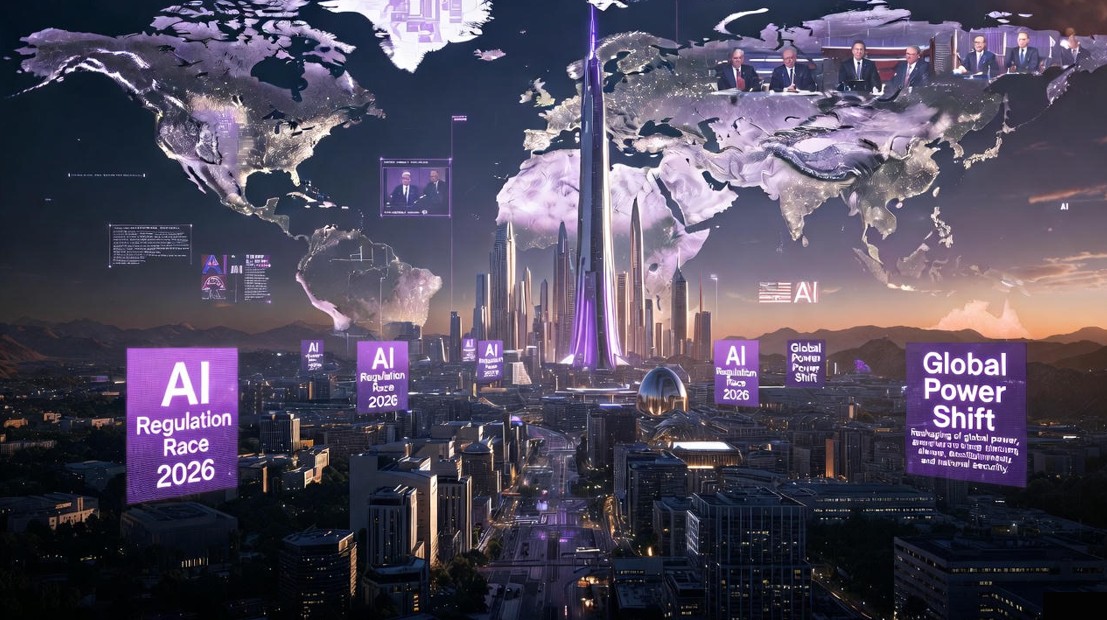
Governments around the world are entering an unprecedented political battle over who controls artificial intelligence, how it is deployed, and what risks it poses to societies, markets, and elections.
What began as a technological challenge has rapidly escalated into one of the defining political conflicts of the decade, involving national security, economic power, information control, and democratic stability.
As AI continues to influence public opinion, reshape industries, and disrupt traditional governance systems, policymakers are scrambling to build regulatory frameworks before the technology outpaces them permanently.
A New Political Fault Line: Nations Are Divided on How to Govern AI
🇺🇸 United States: Congressional Pressure Mounts
U.S. lawmakers are rushing to create a unified federal approach as AI becomes a central issue in governance, cybersecurity, public safety, and election integrity.
Key areas under debate include:
- transparency requirements
- deepfake restrictions
- data protection
- AI involvement in political advertising
- national security safeguards
Parties differ sharply on the level of regulation, making AI one of Washington’s newest ideological battlegrounds.
🇪🇺 European Union: The World’s First Comprehensive AI Law
The EU has taken the most aggressive stance with the AI Act, imposing strict rules on:
- biometric surveillance
- algorithmic transparency
- risk classifications
- consumer protections
EU policymakers argue that only early and expansive governance can prevent future abuses.
🇨🇳 China: State-Controlled AI With Security Priority
China continues to pursue a heavily centralized model, where AI development is shaped by:
- state oversight
- online information management
- national security imperatives
This creates a global divide between open democratic regulation and tightly controlled authoritarian AI ecosystems.
Middle East & GCC: Strategic, Pro-Innovation Frameworks
Countries like the UAE and Saudi Arabia are building ambitious AI frameworks centered on:
- innovation
- investment attraction
- workforce modernization
- smart-government initiatives
Their approach aims to balance safety with technological leadership — a contrast to Western restraint.
Why Governments Are Racing: AI Is Now a Political Power Tool
1. Election Integrity
With AI-generated misinformation and deepfakes growing rapidly, political actors fear manipulation of:
- voters
- public discourse
- media trust
- democratic processes
2. Economic Competitiveness
AI will determine global leadership in:
- finance
- defense
- energy
- healthcare
- robotics
- cybersecurity
Regulation becomes a weapon in economic strategy.
3. National Security
Governments warn of risks from:
- autonomous cyberattacks
- AI-enhanced espionage
- automated disinformation
- battlefield automation
4. Social Control & Stability
Leaders worldwide fear the societal consequences of uncontrolled AI:
- job displacement
- bias
- privacy erosion
- public unrest
The political cost of “doing nothing” has become too high.
The Regulatory Divide: A New Global Ideological Map
AI governance is creating a new political axis:
open-but-regulated democracies vs. state-controlled AI superpowers vs. rapid-innovation economies.
This divide will shape:
- alliances
- trade flows
- technology standards
- digital rights
- global power dynamics
AI is no longer just technology.
It is international politics.
What Comes Next: The 2025–2030 Political Outlook
Analysts expect three major developments:
- AI treaties and international agreements; similar to climate or nuclear accords
- New political populism around AI fears ; jobs, privacy, inequality
- Election-cycle turmoil; AI deepfakes and influence tactics challenging democratic systems globally
Governments are trapped in a race:
regulate fast or lose control forever.
Comments 0



Recommended Post

Top U.S. Lawmaker Accuses DOJ of Cover-Up in Jeffrey Epstein Files

Lindsey Graham’s Rhetoric Fuels Chaos While He Denies Responsibility






Leave a Comment