AI-directed autonomous farming is transforming agriculture through drones, robots, and predictive analytics. Discover how automation boosts yields and reduces costs.

AI-directed autonomous farming is transforming agriculture through drones, robots, and predictive analytics. Discover how automation boosts yields and reduces costs.
Agriculture is undergoing its most profound transformation since the invention of industrial machinery. As climate volatility intensifies and global food demand rises, the farming sector is turning toward a new partner: artificial intelligence. AI-directed autonomous farming has swiftly emerged as a central pillar of modern agritech, reshaping how food is monitored, produced, and delivered. What was once labor-intensive, unpredictable, and heavily reliant on manual expertise is evolving into a data-driven, automated, and highly efficient system.
Traditional farming has long struggled with labor shortages, high input costs, and unpredictable weather patterns. Today, those challenges are being mitigated by integrated systems combining AI, robotics, sensors, and real-time analytics. The modern farm is becoming a digitally orchestrated ecosystem where decisions are guided by data rather than intuition. This shift is enabling farmers to produce more with fewer resources, while maintaining environmental responsibility.
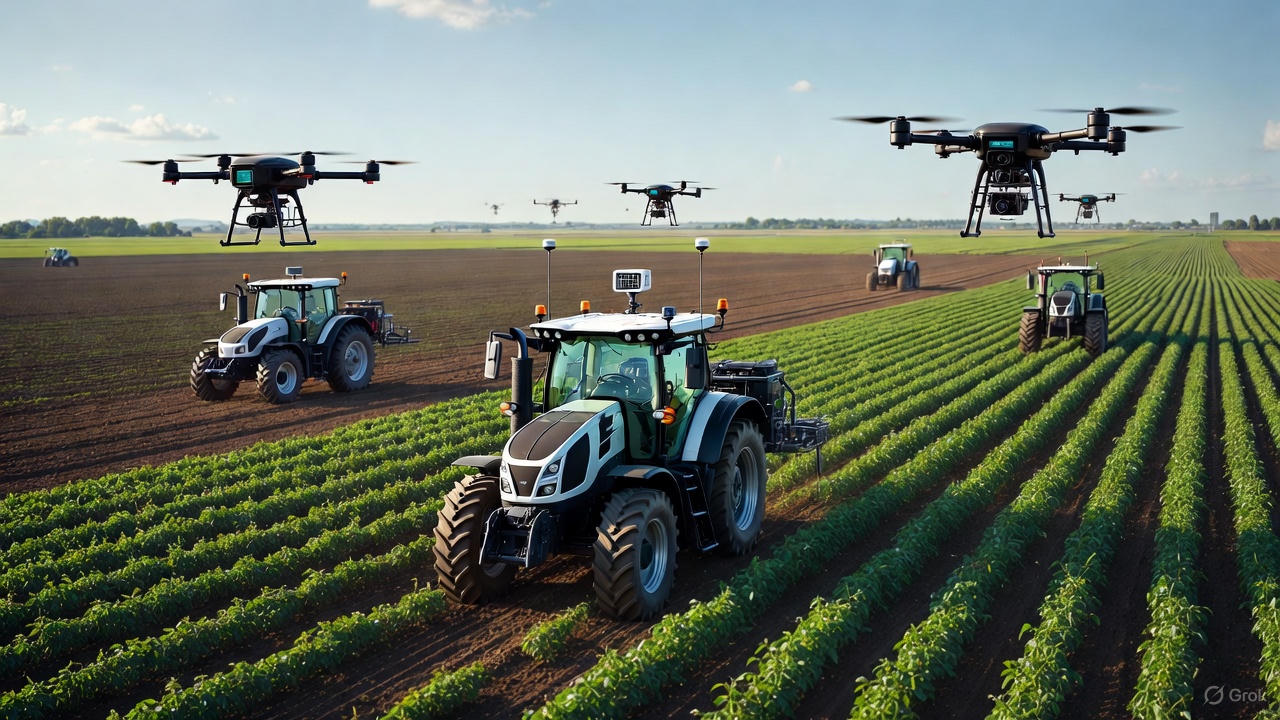
One of the most transformative shifts is in aerial crop monitoring. AI-powered drones conduct scheduled flights across thousands of acres, scanning fields with multispectral and thermal cameras. These devices detect stress points invisible to the human eye, including early signs of disease, drought impact, nutrient deficiencies, and pest activity.
The AI systems behind these drones process the collected imagery and generate detailed field maps. These maps allow farmers to intervene with precision, directing water, fertilizer, or treatments only to affected zones. The results are substantial: reduced costs, higher yields, and healthier crops.
Self-driving tractors, robotic planters, and automated sprayers are rapidly becoming the backbone of large-scale agriculture. Using GPS guidance, machine vision, and LiDAR, these machines can operate with remarkable accuracy, outperforming manual labor in consistency and speed.
Autonomous machinery now handles tasks such as planting seeds at optimal depth and spacing, spraying weeds with pinpoint accuracy, and harvesting crops with minimal human involvement. The level of precision in these operations improves soil health, reduces overuse of chemicals, and maximizes productivity.
Harvesting has historically been one of the agricultural sector’s greatest bottlenecks. Manual pickers face fatigue, labor shortages are common, and timing is critical. AI-enabled robotic harvesters are beginning to solve these issues.
These robots identify ripe produce, pick it delicately to avoid damage, and sort it immediately. They operate continuously without breaks, ensuring that crops are harvested at the ideal moment. The adoption of robotic picking is particularly significant in fruit and vegetable markets where quality and timing directly influence profitability.
Water scarcity and fertilizer waste have long been major concerns, both economically and environmentally. AI-directed irrigation systems use real-time soil moisture sensors, weather predictions, and crop models to optimize water distribution. Instead of watering entire fields uniformly, these systems deliver exactly the amount of moisture each section requires.
Similarly, AI-based fertilization models apply nutrients with surgical precision. This dramatically reduces runoff, protects soil ecosystems, and lowers operational costs. In regions facing drought, these systems can reduce water use by up to half while maintaining crop performance.
The greatest strength of AI in agriculture lies in its capacity to predict. Machine-learning algorithms analyze years of climate data, crop performance, market trends, and soil patterns to forecast yields and identify risks long before they become visible.
This predictive power gives farmers the ability to plan with a level of certainty never before possible. Crop diseases can be mitigated early. Weather-related losses can be reduced. Inputs can be budgeted more efficiently. AI transforms the farm from a reactive environment into a proactive one.
Countries around the world are integrating autonomous farming in different ways:
• The United States deploys autonomous tractors across large commercial farms.
• Japan uses robotic technology to offset an aging rural workforce.
• The Netherlands operates high-tech greenhouses capable of unprecedented crop density.
These examples highlight a global transition toward more efficient, sustainable agricultural systems.
By the next decade, experts predict that farms may operate almost entirely autonomously. AI systems will coordinate everything from planting to harvesting, communicating with drones, robots, and sensors in a synchronized ecosystem. Human roles will shift from physical labor to oversight, management, and strategic decision-making.
Fully autonomous farms promise higher yields, lower environmental impact, greater stability in food production, and resilience in the face of climate uncertainty. The integration of AI into agriculture is not simply an upgrade, it is a complete reinvention of how the world grows its food.



Jeffrey Epstein Scandals: New Revelations, Unanswered Questions, and Global Fallout
February 08, 2026









Comments 0