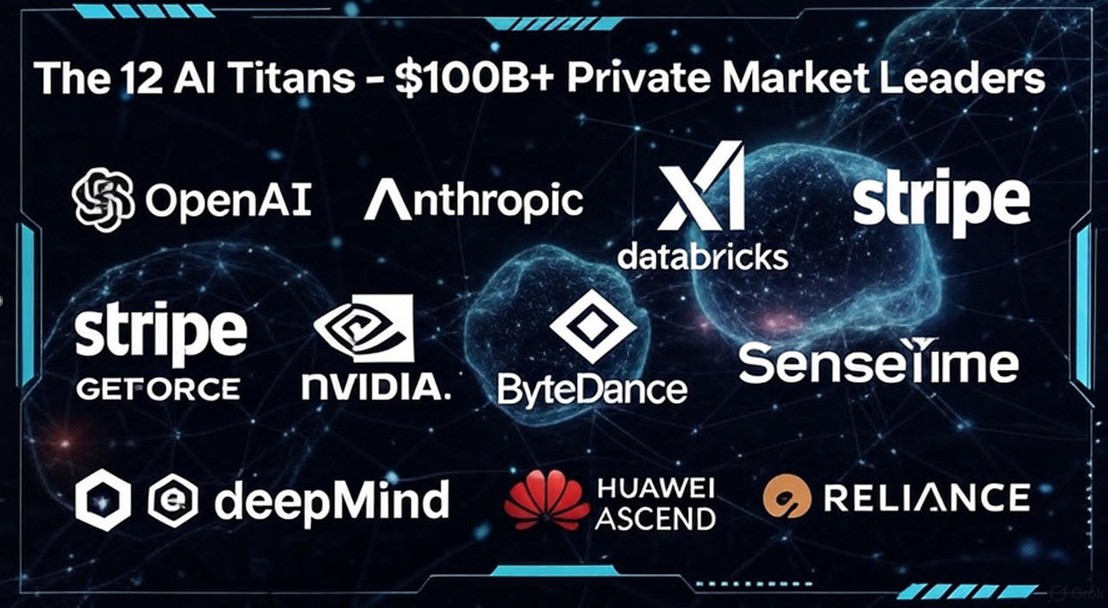
Fifteen private AI companies are positioned to exceed $50B valuation by 2026. These firms represent the next market-defining generation in artificial intelligence.
The artificial intelligence sector has entered its next evolutionary phase: growth is no longer measured by experimentation, but by the speed at which private AI companies can scale revenue, compute capacity, and enterprise adoption. The first tier of the AI economy has already passed the $100 billion valuation threshold, but directly beneath them sits the next class of contenders, private firms currently valued between $10 and $30 billion that are on a credible trajectory toward $50 billion and beyond.
This group represents the future of defensible innovation and concentrated power within AI markets. These companies have strategic positioning, proprietary technology, infrastructure advantage, or geopolitical relevance that makes them candidates for outsized valuation expansion within the next 24 to 36 months. Access to allocation remains limited, often moving through family offices, private equity, sovereign-backed capital, and secondary markets.
Below are the 15 companies most likely to break the $50B threshold next. This is not speculative enthusiasm, it is momentum backed by infrastructure, adoption and capital direction.
The 15 Private AI Companies to Watch Before They Enter the $50B Class
- Scale AI
A core training and data infrastructure provider for foundation models. The labeling backbone of the modern LLM economy. - Perplexity AI
A search engine built for reasoning, verification and answer quality rather than link distribution. - Character.ai
High-retention consumer AI platform creating a new category of digital interaction and entertainment. - Inflection AI
Developer of Pi, a personal conversational AI focused on emotional intelligence and long-term memory interaction. - Hugging Face
The open-source infrastructure layer for machine learning; the model hub of the global research ecosystem. - Cerebras Systems
Waferscale compute architecture capable of training models beyond the limitations of conventional GPUs. - Groq
Real-time inference processing at speeds materially above GPU performance, unlocking low-latency AI applications. - ElevenLabs
Advanced synthetic voice technology used by film, broadcasting and enterprise media at production-grade output. - Runway ML
Video generation infrastructure changing advertising, film and professional media production workflows. - Mistral AI
Europe’s leading generative AI engine producing high-performance open-weight models gaining global enterprise traction. - SambaNova Systems
Full-stack AI compute for enterprises and government-grade workloads, optimized for large-model inference. - Cohere
Enterprise-focused LLM platform with emphasis on security, privacy, and custom training for sector-specific applications. - Dataminr
Real-time risk and event signal detection used by corporations, markets, intelligence and emergency-response networks. - Glean
AI-powered enterprise knowledge search, indexing internal documentation and operational data at global scale. - Anduril Industries (AI Systems)
Advanced autonomous defense platforms, sensor networks and battlefield intelligence. A likely future defense-AI prime.
This list reflects companies with defensible moats, accelerating adoption and positioning inside markets where AI infrastructure will become a requirement rather than an option.
What Makes These Firms Likely to Cross $50B
- Revenue acceleration driven by enterprise and institutional integration.
- Infrastructure technology rather than consumer-layer volatility.
- Hardware breakthroughs capable of shifting compute economics.
- Strategic relevance to national security and sovereign digital policy.
- Potential IPO and secondary offerings between 2026 and 2028.
The next dominant AI institutions will not simply build applications. They will own the layers that applications are forced to run on.
Comments 0